
A cabinet door starts to swell near the dishwasher. A shelf bows under a stack of plates. A screw spins loose in the side panel. Most homeowners blame the finish or the installer. Often the real cause sits inside the cabinet: the panel.
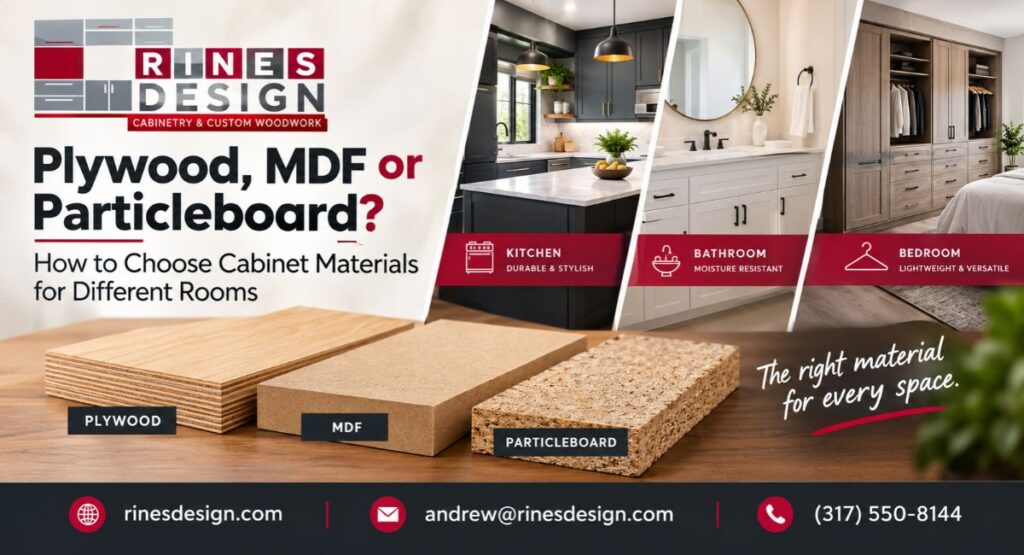
Cabinets are built from sheet goods. The three most common are plywood, medium-density fiberboard (MDF) and particleboard. They look alike once painted or wrapped. They behave very differently under water, weight and daily use.
That is why the plywood vs particle board question has no single answer. Each material wins in some places and loses in others. Plywood often suits boxes that face moisture. MDF often suits painted doors. Particleboard often suits dry, budget-friendly builds. The right pick depends on the room, the job and how the cabinet is built.
This guide compares plywood, MDF and particleboard by application. You will see how panel stability, edge finishing, fastening, moisture exposure, weight and finish quality play out in real rooms. You will also see why product grade, construction and installation can matter as much as the material name. By the end, you will know what to ask for, what to check and where to spend your budget.
Which Cabinet Material Is Best?
No material wins everywhere. Match the panel to the job.
Here is the short version:
- Plywood: the best all-round choice for cabinet boxes, especially near water. It holds screws well and handles moisture better than most panels.
- MDF: the best choice for painted cabinet doors and smooth, routed panels. It stays flat and takes paint evenly.
- Particleboard: a fit for dry areas and tight budgets. It works in closets, garage storage and light-duty boxes when the grade is good and the build is sound.
Those are patterns, not promises. A well-made particleboard cabinet with a durable laminate face can outlast a cheap plywood cabinet with thin, gappy inner layers. Grade matters. So do the glue, the edge sealing and the way the cabinet is assembled.
If you want one rule, follow this one. Put your strongest, most moisture-tolerant panel where water, weight or screws will test it. Put your smoothest panel where paint or a wrapped finish will show. Put your most economical panel where it will stay dry and carry light loads.
What Plywood, MDF and Particleboard are made of
Panel makeup explains almost every performance difference. So it helps to start there.
Plywood
Plywood is built from thin wood layers called plies. Each layer is glued to the next with its grain turned ninety degrees. This cross-banding is the key feature. It limits how much the panel swells and shrinks across its width. It also gives plywood long fibers that grip screws.
Cabinet shops use hardwood plywood, often with a birch, maple or oak face veneer. Veneer is a thin slice of real wood glued to the surface. Quality depends on the core. Some cores are made of many tight plies. Others use fewer, thicker layers with gaps called voids. Voids weaken edges and reduce screw hold. Standards such as ANSI/HPVA HP-1 describe grades for hardwood and decorative plywood, so ask what grade a supplier uses.
MDF
Medium-density fiberboard is made from fine wood fibers. Resin binds the fibers. Heat and pressure press them into a dense, uniform sheet. There is no grain and no knots. The surface is very smooth.
That smoothness makes MDF a favorite for painted doors and routed profiles. The panel also moves very little across its width. The trade-off is water. When the core is exposed, MDF absorbs moisture quickly and swells. It rarely returns to its original shape. Moisture-resistant MDF exists, and it is often tinted to tell it apart, but it is not waterproof.
Particleboard
Particleboard is made from wood chips, shavings and sawdust pressed with resin. Industry standards, including ANSI A208.1, grade it by density and strength. Cabinet makers usually pair it with melamine, laminate or veneer. Melamine is resin-treated paper fused to the surface. It gives a hard, wipe-clean face.
The core is the weak spot. It holds screws less well than plywood. It also swells at the edges when water gets in. In a dry room with a sealed edge, it can serve for years.
Related Terms You Will See
Thermofoil is a vinyl film heat-pressed onto an MDF door. Hardwood means solid wood, used for door frames, face frames and drawer boxes. Moisture-resistant panels include exterior-glue plywood and treated MDF or particleboard. These labels describe features, not guarantees. Always ask how the panel was made and what it was tested for.
Plywood vs MDF vs Particleboard at a Glance
The table below compares the three panels on the factors that affect cabinets most. Treat it as a starting point. Results shift with grade, brand and build quality.
| Factor | Plywood | MDF | Particleboard |
| Panel stability | Very good across the width because of cross-banded layers | Good, with no grain movement | Fair to good, depends on density |
| Edge finishing | Shows plies, so it needs banding or a face frame | Machines smooth, but needs sealing | Coarse edges, needs tight edge banding |
| Screw holding | Best of the three | Good in the face, weaker at edges | Lowest, and stripped holes rarely recover |
| Moisture exposure | Best with exterior-grade glue, but long soaking can separate layers | Swells fast at exposed cores | Swells at edges and rarely recovers |
| Weight | Usually the lightest | Usually the heaviest | In between |
| Finish quality | Grain may show through paint | Smoothest base for paint | Smooth under melamine or laminate |
| Best fit | Boxes, wet-adjacent areas, heavy loads | Painted doors, panels, trim | Dry boxes, closets, budget builds |
No row in this table declares a universal winner. That is the point. Each panel earns its place in a different part of the cabinet.
How Cabinet Substrates Affect Durability
The substrate is the panel under the surface. It decides how a cabinet ages. Here is how the six main factors play out.
Panel Stability
Stability means a panel stays flat and keeps its size as humidity changes. Plywood’s alternating layers pull against each other, which limits movement. MDF has no grain, so it moves evenly and stays flat on wide doors. Particleboard also has no grain, but low-density grades can sag across long spans.
Shelves show this first. A wide shelf loaded with dishes can bow over time. Plywood handles the same span better than most particleboard. A center support or a shorter span helps any panel.
Edge Finishing
Edges reveal what a panel is made of. Plywood edges show thin layers. Some designers like that look. Most cabinet makers cover the edges with banding or a face frame.
MDF edges machine smooth and take profiles well. They also soak up paint and water, so they need sealing. Particleboard edges are coarse. They need banding with a tight glue line. A lifted or chipped band lets water in and starts swelling. Good edge work often matters more than the core you cannot see.
Fastening and Screw Holding
Hinges, drawer slides and shelf pins all depend on screw hold. Plywood grips screws well because its long fibers run in alternating directions. MDF holds screws in its face but can split near edges, so installers pre-drill. Particleboard has the weakest hold. A stripped hole rarely tightens again.
Cabinet makers improve joints with glue, dowels, confirmat screws and hardware plates. Hardware layout also spreads load. Our cabinet hardware placement guide shows where pulls and hinges sit for comfort and strength.
Moisture Exposure
Water is the toughest test. Sinks, dishwashers, vanities and laundry rooms see steam, drips and spills. Plywood with exterior-grade glue handles short exposure best. Long soaking can still separate its layers.
MDF and particleboard absorb water fast at cut edges and screw holes. Moisture-resistant grades help. In practice, sealing every edge and hole protects them best. Poor ventilation adds humidity that any panel will feel over time.
Weight and Handling
Weight affects shipping, hanging and the strain on hinges. MDF is usually the heaviest of the three. Plywood is usually the lightest. Particleboard sits in between.
A tall pantry door in MDF puts extra load on its hinges. Makers add a third hinge or choose hardware rated for the weight. Wall cabinets built from heavy panels also need solid fastening into studs. Lighter boxes are easier to lift, level and hang.
Finish Quality
Paint and wrapped finishes show every flaw below them. MDF gives the smoothest surface, so painted doors look crisp. Open-grain plywood, such as oak, can telegraph its grain through paint unless it is filled first.
Particleboard works well under melamine, laminate or a thermofoil-style wrap. Veneered plywood gives real wood grain for stained finishes. Whatever the panel, a good finish starts with careful prep.
Which Material is Best for Cabinet Doors and Which for Boxes?
A cabinet is not one part. The box and the door face different demands. So they often use different panels.
Cabinet Boxes
The box carries weight and holds the hardware. It also sits closest to plumbing and floors. That is why many custom shops choose plywood cabinet boxes for kitchens, baths and laundry rooms. Plywood grips screws, carries loads and tolerates a splash better than most options.
Particleboard with a melamine face is common in frameless, budget-focused lines. It works well in dry rooms. It needs sealed edges and well-planned supports. MDF is used less often for boxes because it is heavy and weak at the edges.
Cabinet Doors and Drawer Fronts
Doors need to stay flat, take a finish well and resist cracking at the joints. This is where MDF shines. An MDF center panel in a shaker door stays flat and holds paint without showing grain. MDF slab doors give a clean, modern face for paint or thermofoil.
Solid hardwood frames suit stained doors and traditional profiles. Wood moves with humidity, so painted hardwood joints can show fine hairline gaps over time. Many makers pair a hardwood frame with a plywood or MDF panel to balance looks and stability. Veneered plywood works for slab doors with a continuous wood grain.
So which material is best for cabinet doors? For paint, MDF is often the top pick. For stain, hardwood or veneered plywood usually leads. For a wrapped, low-maintenance face, thermofoil over MDF works in dry areas but can peel near heat and steam.
Door style also changes what a panel must do. Inset doors sit inside the frame with tight gaps, so stability matters even more. Our comparison of inset vs full overlay cabinets explains how each style affects fit and door choice.
Mixed Builds
The smartest builds mix materials. A plywood box with MDF painted doors is a common pairing. A melamine closet box with hardwood shelf edging is another. Mixing lets each part do what it does best, and it keeps cost where it counts.
Cabinet Materials for Humid Rooms and Every other Room
Room conditions should guide the choice. Moisture, heat and load change from room to room. The table gives a practical starting point.
| Room or area | Suggested box | Suggested door | Main concern |
| Kitchen sink base | Plywood with sealed edges | Painted MDF or hardwood | Leaks and steam |
| Kitchen uppers and pantry | Plywood or quality particleboard | Painted MDF, hardwood or veneer | Weight on hinges |
| Bathroom vanity | Plywood | Sealed MDF, hardwood or veneer | Steam and splashes |
| Laundry room | Plywood | Painted MDF or laminate | Leaks and humidity |
| Closets | Melamine particleboard or plywood | Matching panel or hardwood | Shelf sag |
| Bar or coffee station | Plywood | Painted MDF or hardwood | Spills near a sink |
| Living room built-ins | Plywood | Painted MDF or veneer | Fit and finish |
Kitchens
The sink base takes the most abuse. Plywood works well here, with every cut edge and plumbing opening sealed. A waterproof liner under the sink helps all panels. Dishwasher steam can reach nearby door edges, so use a heat shield and keep the seal intact. Dry upper cabinets give you more freedom. For a full kitchen plan, see our custom kitchen cabinetry service.
Bathrooms
Bathrooms are the toughest test. Showers add steam. Vanities sit near drips and spills. Plywood boxes are the safer base. MDF doors can work if every face and edge is sealed and painted well. Thermofoil can peel under heat and moisture, so it is a weaker pick here. Details like these shape our bathroom vanities work.
Laundry Rooms
Washers can leak, and dryers raise humidity. Plywood boxes handle this better than most options. Seal the countertop edges, add a drip tray where it fits, and keep the room ventilated. Upper cabinets in this room stay drier, so they have more flexibility.
Closets, Bars and Built-Ins
Closets are dry, so melamine particleboard is a sound, economical choice. Plan for shelf supports, since long spans and heavy loads cause sag. Bars and coffee stations often include a small sink, so plywood boxes make sense. Living room and office built-ins show their finish up close, so painted MDF doors and plywood boxes often give the best mix of looks and strength.
Why Grade, Construction and Installation Matter
Two cabinets can both say “plywood.” They may perform nothing alike. Grade, build method and installation set the real result.
Product Grade
Plywood grades vary by veneer quality, core layers and glue. Particleboard and MDF vary by density, resin and moisture treatment. The Composite Panel Association publishes resources on particleboard and MDF grades and quality marks. Ask suppliers which grade they use. Also ask about formaldehyde compliance. In the United States, composite wood products follow EPA TSCA Title VI limits, which align with California’s CARB Phase 2 rules.
Construction
A strong panel can still fail in a weak design. Look at these details:
- Panel thickness, since 3/4 inch is typical for boxes and thinner stock suits backs
- Joinery such as dados, dowels and glue, rather than staples alone
- Back panels that add rigidity
- Sealed edges, including inside sink bases
- Shelf spans that match the load
Installation
Installation can undo good materials. Cabinets need a level base, shims where needed and fasteners into studs. Cut-outs for pipes should be sealed. Countertops and backsplashes need tight joints near water. Good ventilation protects every panel in a humid room.
A skilled custom cabinet maker in Indianapolis will explain these choices in plain terms. If a shop cannot say what is inside the box, ask again.
Cost and Budget Trade-Offs
Price often drives the first conversation. In most markets, particleboard costs the least, MDF sits in the middle and plywood costs the most. Exact prices change by grade, thickness, supplier and region, so treat this as a general pattern.
The cheapest panel is not always the cheapest cabinet. A swollen sink base can mean a full replacement. A stripped hinge hole can mean a repair visit. Over many years, a stronger panel in the right spot can cost less than a weaker one that fails early.
A split budget often works best. Spend on plywood boxes where water, weight and screws are a concern. Save with particleboard or melamine in dry areas such as closets and upper cabinets. Choose MDF doors when you want a painted finish at a fair price. This approach puts money where failure costs the most.
Workshop Sample Tests You Can Try
Samples tell you more than a spec sheet. A good shop keeps sample squares of each panel and lets you handle them. If you visit a workshop, ask for equal pieces of plywood, MDF and particleboard, each about six inches square. Then compare them side by side.
Weight. Pick up each piece. The difference is easy to feel. MDF usually feels densest, and plywood usually feels lightest.
Edges. Look closely at a cut edge. Plywood shows layers and any voids. MDF looks smooth and fine. Particleboard looks coarse and grainy. Ask how each edge would be sealed or banded.
Screw hold. Ask the maker to drive a screw near an edge in each sample. Then back it out and drive it again. Plywood usually grips best. Particleboard usually loosens fastest. This shows why reused screw holes matter.
Moisture. Ask how the shop seals samples. Compare a sealed edge with a bare one. A bare MDF or particleboard edge swells quickly after contact with water. Do not soak your own samples at home and treat the result as a lab test. It is only a rough guide.
Finish. Hold painted and veneered samples under bright light. Look for grain showing through paint, soft edges and uneven sheen. These flaws point to prep quality as much as panel choice.
These checks are simple demonstrations. They do not replace product testing. Performance still depends on grade, construction and installation.
How To Choose Cabinet Materials in Five Steps
Use this order to make the decision with less guesswork.
- Map each room’s exposure. Note where water, steam, heat or heavy loads show up.
- Choose the box material. Pick plywood for wet-adjacent or heavy-duty cabinets. Consider quality particleboard for dry, light-duty ones.
- Choose the door material. Pick MDF for paint, hardwood or veneer for stain, and thermofoil only in dry, cooler areas.
- Ask about grade and build. Request panel grade, thickness, joinery, back panel details and edge sealing methods.
- Review samples and a written spec. Confirm the materials by room before work starts.
Plywood vs Particle Board: Frequently Asked Questions
Is plywood better than particle board for cabinets?
Plywood is usually the stronger and more moisture-tolerant choice for cabinet boxes. It holds screws better and handles splashes better. Particleboard can still suit dry, light-duty cabinets when the grade is good and the edges are sealed.
Is MDF better than plywood for cabinet doors?
For painted doors, MDF is often the better pick. It is smooth, flat and stable across the width. Plywood is better when you want real wood grain or a lighter, stronger panel.
Can MDF cabinets go in a bathroom?
Yes, if every face and edge is sealed and painted well, and the room is ventilated. Plywood boxes with sealed MDF or hardwood doors are a safer setup than MDF throughout.
Are particleboard cabinets bad?
No. Quality varies. Good particleboard with a durable melamine face and tight edge banding works in closets, garages and dry storage. It struggles with water, heavy loads and repeated screw removal.
Which cabinet material holds screws best?
Plywood holds screws best of the three. MDF holds well in the face but can split near edges. Particleboard holds least and loosens if a screw is removed and replaced.
Which panel is heaviest?
MDF is usually heaviest. Plywood is usually lightest. Particleboard falls between them. Weight changes hinge choice and wall mounting needs.
Do plywood cabinets cost more?
Usually, yes. Plywood tends to cost more than particleboard and MDF. The higher cost often pays back in sink bases, vanities and any cabinet that carries heavy loads.
The Takeaway: Match The Panel To The Job
There is no universal winner in the plywood vs MDF vs particleboard debate. Plywood suits boxes that face moisture and weight. MDF suits painted doors and smooth panels. Particleboard suits dry, light-duty and budget-minded builds. Grade, construction and installation decide how well any of them last.
Start with the rooms. Mark the wet spots, the heavy loads and the finishes you want. Then match each part of the cabinet to those conditions.
Ready to plan your project? Rines Design builds custom wood work for kitchens, baths, laundry rooms and built-ins, with materials chosen room by room. Contact Rines Design to talk through your plans and review panel samples before you decide.